
Dr. Anand S
Co-Founder · MDS, Endodontics
Dentin hypersensitivity — commonly known as tooth sensitivity — affects an estimated 10–30% of the adult population. It presents as a short, sharp pain in response to stimuli such as cold, heat, sweet foods, or even cold air.
The Mechanism
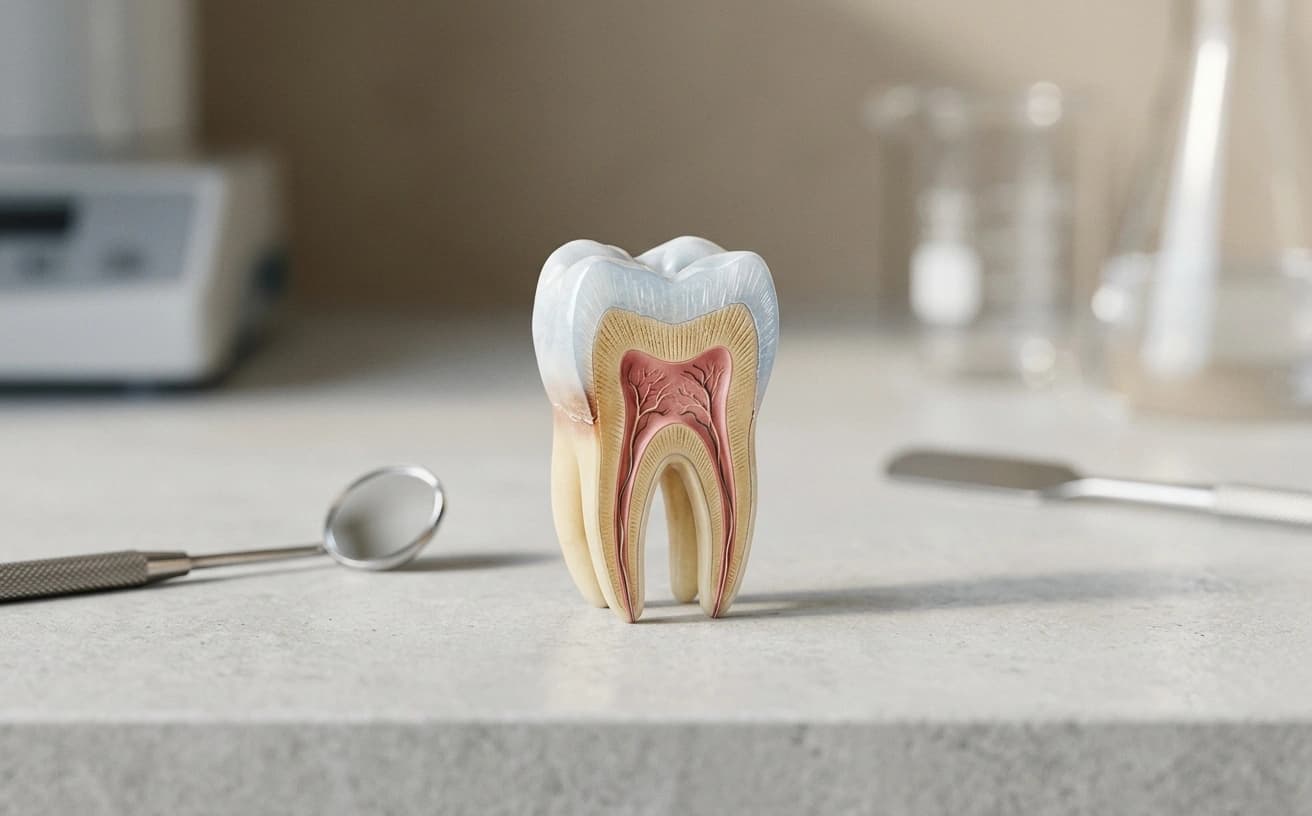
Teeth have an outer protective layer of enamel (on the crown) and cementum (on the root). Beneath these lies dentin, which contains thousands of microscopic tubules leading to the nerve. When enamel or cementum is lost or compromised, these tubules become exposed, allowing stimuli to reach the nerve and trigger pain.
This is known as the hydrodynamic theory of dentin sensitivity, first described by Brännström in 1964 and still the most widely accepted explanation.
Common Causes
- Gum recession exposing root surfaces.
- Enamel erosion from acidic foods, beverages, or gastric reflux.
- Aggressive brushing with a hard-bristled toothbrush.
- Tooth grinding (bruxism) wearing down enamel.
- Recent dental procedures (temporary sensitivity).
- Cracked or chipped teeth.
Treatment Options
Treatment depends on the underlying cause:
- Desensitising toothpaste: contains potassium nitrate or stannous fluoride that block tubule transmission. Requires consistent use for 2–4 weeks.
- Professional fluoride application: high-concentration fluoride varnish applied in-office to strengthen exposed dentin.
- Bonding or sealants: covering exposed root surfaces with composite resin or dentin sealants.
- Gum grafting: for cases of significant recession, soft tissue grafts can cover exposed roots.
- Night guard: if bruxism is the cause, a custom guard protects against further enamel loss.
A Cochrane systematic review found that potassium nitrate-containing toothpastes provide clinically meaningful reduction in dentin hypersensitivity when used twice daily for at least 6–8 weeks.
When Sensitivity Indicates a Larger Problem
Sensitivity that is confined to a single tooth, spontaneous, or worsening may indicate a crack, deep decay, or pulp inflammation rather than generalised dentin hypersensitivity. A clinical evaluation can distinguish between the two and determine the appropriate treatment.
References
- 1.Brännström M, Aström A. The hydrodynamics of the dentine. International Dental Journal. 1972;22(2):219–227.
- 2.Orchardson R, Gillam DG. Managing dentin hypersensitivity. Journal of the American Dental Association. 2006;137(7):990–998.
- 3.Cunha-Cruz J, et al. Dentin Hypersensitivity and Oxalates: A Systematic Review. Journal of Dental Research. 2011;90(3):304–310.